
The spring serpent · Constellation and myth
Hydra: The Longest Serpent in the Sky
It takes most of a spring night to see the whole of it, and from the far north you never quite can. The water snake, the monster of Lerna, and the small companions riding on its back.
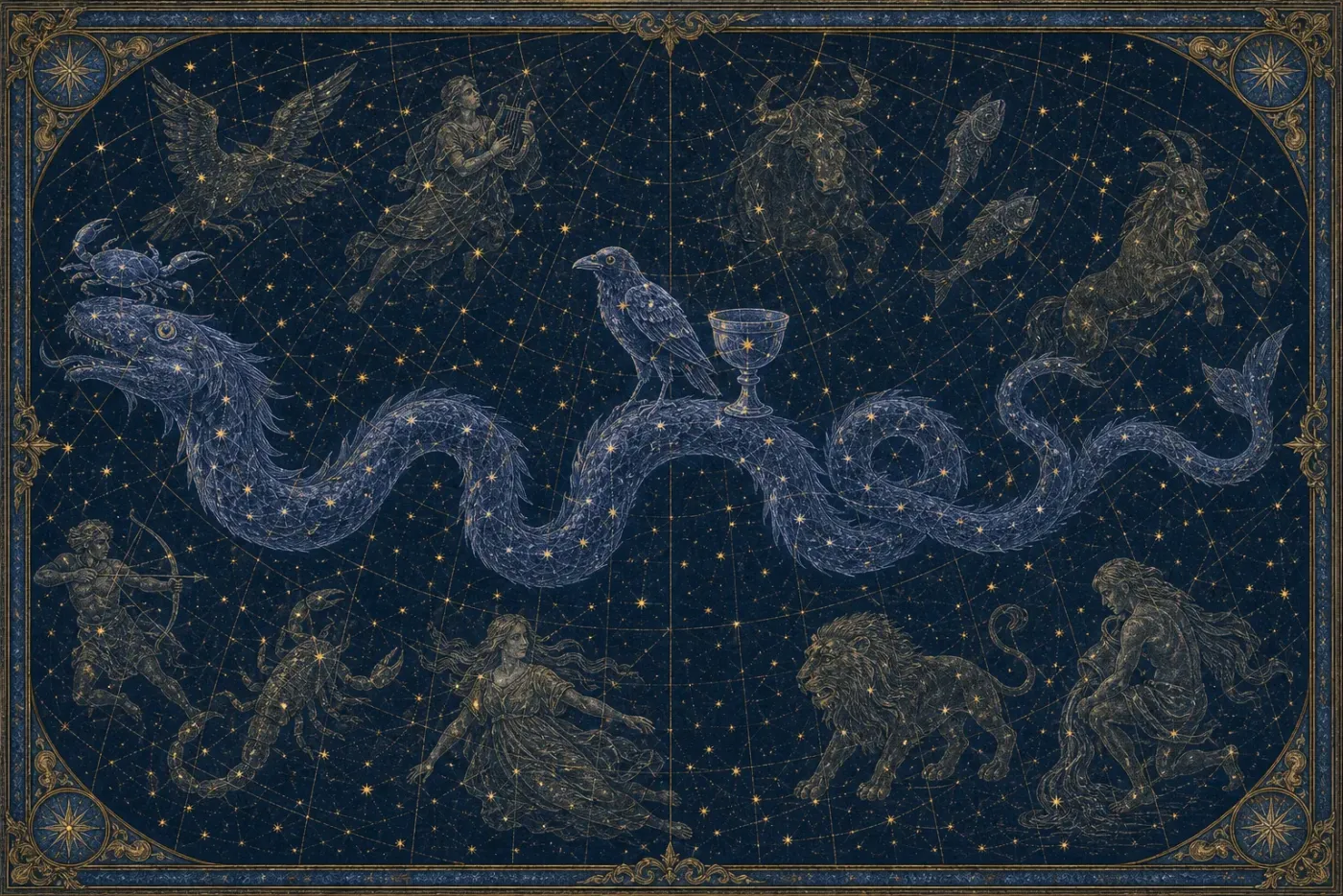
Most constellations can be taken in at a glance. Hydra has to be followed. On an evening in early spring, its head rises in the east as a small, neat knot of stars just below the faint constellation of Cancer; the rest of the serpent comes up behind it over the following hours, a long, dim, wandering line low across the southern sky. By the time its tail clears the horizon, the head is already sinking in the west. Hydra is the largest of the 88 modern constellations, and it is shaped like patience.
The monster of the marsh
The second labour of Heracles took him to the swamps of Lerna, near Argos, where a many-headed water serpent lived in a spring and laid waste to the countryside. Ancient authors cannot agree how many heads it had. Apollodorus gives nine, the middle one immortal; other writers give far more. Every account agrees on the nightmare at the centre of the story: each time Heracles struck off a head, two more grew in its place.
He could not win alone. His nephew Iolaus set fire to a nearby wood and, as each head fell, seared the stump with a burning brand so that nothing could grow back. The immortal head Heracles cut off and buried under a heavy rock beside the road. Then he dipped his arrows in the creature’s venom, a decision that would shape the rest of his life. Eurystheus, the king who set the labours, refused to count this one at all, because the hero had had help.
A crab on Hera’s orders
In the middle of the fight, Hera, who never stopped trying to destroy Heracles, sent a giant crab out of the marsh to bite his foot. He crushed it without much ceremony. According to the star myths collected under the name of Eratosthenes and retold by Hyginus, Hera then set the crab among the stars as a reward for its loyalty: the constellation Cancer. It is faint, but it holds a treasure, the Beehive cluster, a hazy swarm of stars that binoculars turn into a sparkling handful. Look for the crab just above the serpent’s head, as if the two were still locked together.
The raven, the cup and the snake
The constellation Hydra has a second story, and it is a gentler one. Ovid tells it in his Fasti. The god Apollo sent his raven to fetch water in a cup for a sacrifice. On the way the raven spotted a fig tree whose fruit was not yet ripe, and sat down to wait for it. When it finally flew back, late, it carried a water snake in its claws and claimed the snake had blocked the spring. Apollo was not fooled. He set all three in the sky — the raven as Corvus, the cup as Crater, the snake as Hydra — and arranged them so that the bird would be kept from drinking forever. Look on a May evening and you will find Corvus, a little four-sided sail of stars, perched on the serpent’s back, the cup just behind it, just out of reach. In another of Ovid’s stories the raven is turned from white to black for carrying bad news; the bird comes out of neither tale well.
The solitary one
Hydra’s brightest star is Alphard, an orange giant of the second magnitude. Its name comes from an Arabic phrase meaning “the solitary one,” and once you have found it you will understand why: it shines alone in a broad, empty stretch of sky, with no bright neighbours to keep it company. To find it, start at Regulus, the brightest star of Leo, and drop down and to the right toward the horizon. The first bright, warm-coloured star you reach, alone in an empty patch of sky, is Alphard.
There is something fitting about a monster that grew new heads being represented, in the end, by one lonely star. The Hydra of the myth was all excess. The Hydra of the sky is quiet and spread thin, mostly made of faint stars that a city sky will erase entirely. To see it whole you need darkness, a low southern horizon and a little time.
A serpent at the edge
The name has travelled outward, too. One of the small moons of Pluto, discovered in 2005, is called Hydra, keeping company with a moon named for the underworld’s three-headed dog. Astronomers like their families to stay together, even at the edge of the solar system.
Sources and notes
- Apollodorus, Library 2.5.2, trans. J. G. Frazer (1921), via Perseus; Hyginus, Astronomica 2.23 and 2.40.
- Ovid, Fasti 2.243–266, paraphrased. The number of the Hydra’s heads differs from author to author.
- Altitudes are approximate, calculated for the star’s highest point above each city.