
The summer crown · Constellation and myth
Hercules: The Kneeling Hero of Summer Nights
The Greeks first saw a man on his knees whose name nobody knew. Only later did they decide he was the hero of the twelve labours.
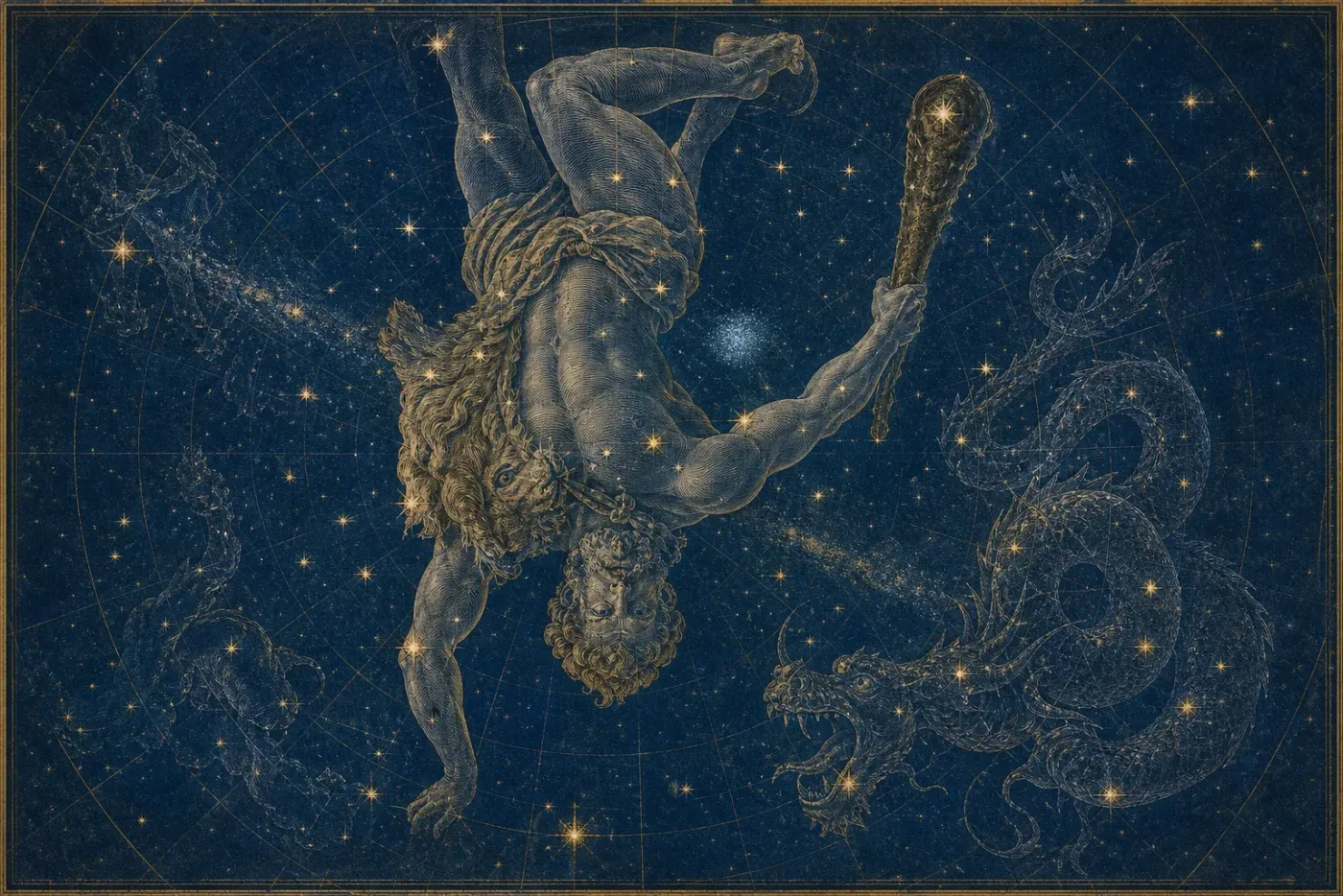
On a clear July night, somewhere away from the lights, lie back and look almost straight up. Between the blue-white blaze of Vega and the orange glow of Arcturus there is a patch of sky that seems, at first, to hold nothing much: no bright stars, no obvious shape. Give your eyes ten minutes. Slowly a lopsided square of four modest stars appears, like the keystone of an arch. That is the body of a hero, and he is upside down.
A man with no name
The oldest surviving description of these stars comes from the poet Aratus, who wrote his Phaenomena, a verse guide to the constellations, in the third century BCE. He describes a figure who looks like a man labouring, sunk on one knee, his arms stretched out — and he admits that nobody can say who the man is or what his toil is about. The Greeks simply called him Engonasin, “the one on his knees.” He is one of the most honest moments in ancient astronomy: a shape everyone could see and no one could explain.
Later writers were not content to leave him nameless. The catalogues of star myths that go under the name of Eratosthenes, and the Roman writer Hyginus after them, identify the kneeler with Heracles, caught in the middle of a struggle with the serpent that coils beside him — the dragon who guarded the golden apples of the Hesperides, whom we now call Draco. In that reading, the hero’s foot is planted on the dragon’s head forever. Other ancient authors suggested Theseus, or even Prometheus. The sources disagree, but the name that stuck was Hercules, the Latin form of Heracles.
Arabic astronomers kept the old idea alive. The star that marks his head is still called Rasalgethi, from an Arabic phrase meaning “the head of the kneeling one.” It sits close to the head of another giant figure, Ophiuchus, so that the two men meet head to head in the summer sky, one upright and one inverted.
Twelve labours, scattered across the sky
The labours themselves have a dark beginning. Driven mad by the goddess Hera, who hated him from birth, Heracles committed a terrible crime against his own family; to atone, he was bound to serve his cousin Eurystheus, king of Tiryns, and perform whatever tasks were set. The mythographer Apollodorus says there were meant to be ten, but Eurystheus refused to count two of them, and so the labours became twelve.
What is remarkable, when you look at a whole year of skies, is how many of those labours are up there. The first was the Nemean lion, whose skin could not be pierced; Heracles strangled it and wore its hide ever after, and the lion became Leo, the great backwards question mark of the spring evenings. The second, the many-headed Hydra, stretches across the spring sky as the largest constellation of all, with Cancer, the crab sent to bite the hero’s heel, nearby. The dragon of the Hesperides coils around the northern pole as Draco. And for a time there was even a constellation for the last labour, the hound of the underworld — a figure later dropped from the maps.
So the kneeling hero is not alone. On a long Canadian year of clear nights you can walk through his life: lion in spring, serpent and crab in the south, dragon in the north all year, and the hero himself overhead when summer comes.
A ball of ancient light
Hercules guards one of the finest sights in the northern sky. On the western side of the Keystone lies M13, the Great Globular Cluster, a tightly packed swarm of several hundred thousand stars. Edmond Halley, of comet fame, noted it in 1714. Under a dark sky it can be glimpsed with the naked eye as a faint, fuzzy star; in ordinary binoculars it becomes a small round glow, brighter in the middle, unmistakably not a single point.
Its distance is roughly 25,000 light-years. That means the light reaching your eye on a summer night left the cluster during the last ice age, when great ice sheets covered most of what is now Canada and no one in the world had yet heard a story about Heracles. In 1974 astronomers even beamed a short radio message from the Arecibo telescope toward M13, a greeting that will need about as long again to arrive.
Why he kneels
It is tempting to wish the hero had been given a grander pose — standing, triumphant, the lion skin over his shoulder. But perhaps the kneeling figure is truer to the story. The labours were not glorious adventures; they were penance, toil done on someone else’s orders, one exhausting task after another. Aratus could not name the man, but he saw exactly what he was doing: working, on his knees, without end. On a warm night, with the crickets loud and the sky turning slowly overhead, he can feel like the most human figure in the heavens.
Sources and notes
- Aratus, Phaenomena 63–70, trans. G. R. Mair (1921); Hyginus, Astronomica 2.6.
- Apollodorus, Library 2.4.12–2.5.12, trans. J. G. Frazer (1921), via Perseus.
- Distances and star counts for M13 are rounded; published values vary slightly.