
Around the Pole · Constellation and myth
Atalanta and the Great Bear: Huntresses of the Northern Sky
Atalanta has no constellation of her own. But the bear that raised her, and the huntress who became a bear, circle the pole above every Canadian night.
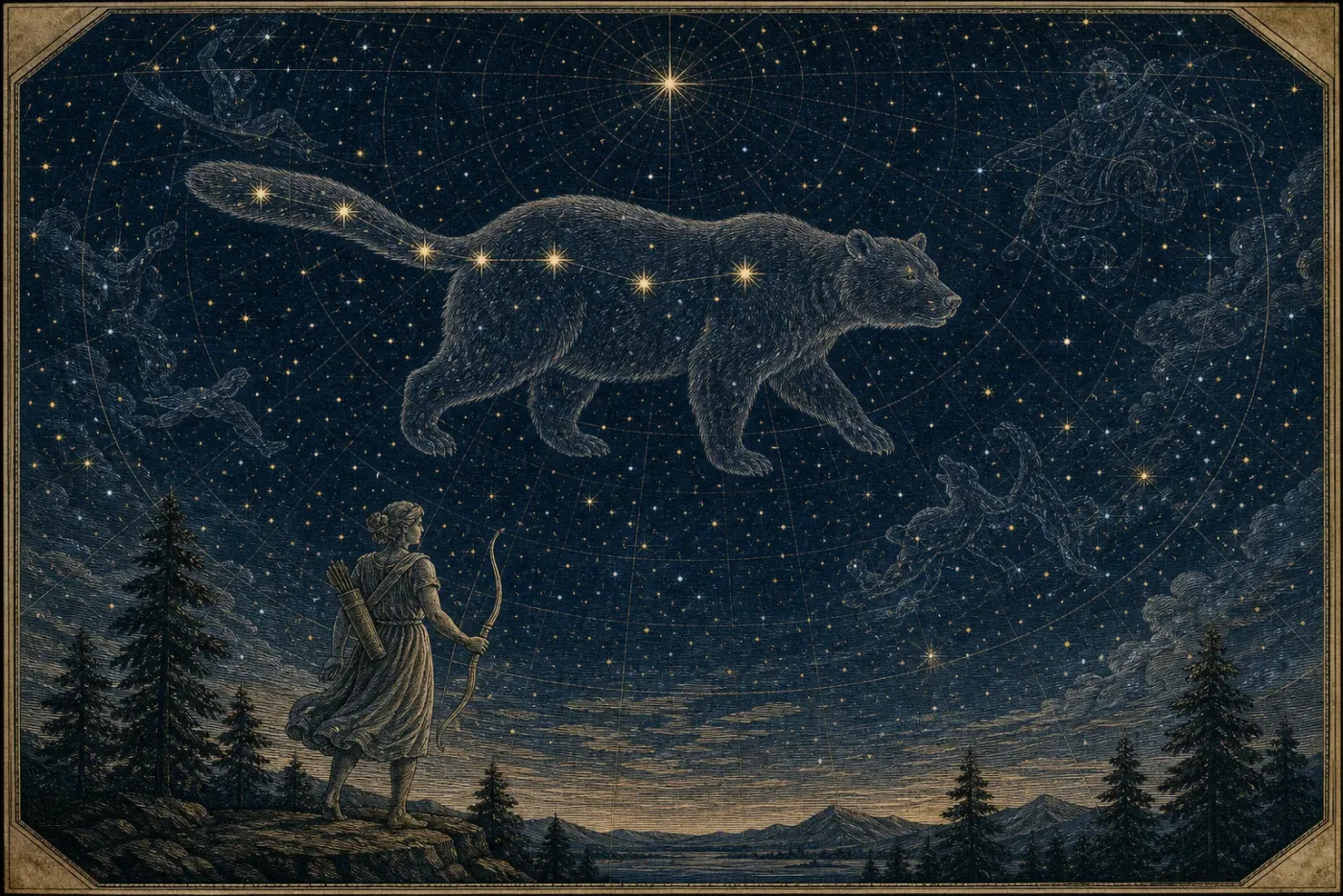
If you have looked up at night anywhere in Canada, you have probably seen the Big Dipper, even if you did not know its name. Seven stars, a bowl and a bent handle, swinging slowly around the north. To the Greeks, those stars were only part of a larger figure: a great bear, Arktos, whose name lives on in our word Arctic — the region under the Bear. And behind the bear were women: huntresses from the wild uplands of Arcadia, in the heart of the Peloponnese.
A child on the mountain
Atalanta’s story begins with rejection. Her father wanted a son, and when a daughter was born he had her left on a mountainside to die. According to Apollodorus, a she-bear found the baby and nursed her, coming back again and again until a band of hunters discovered the child and raised her as their own. She grew up the fastest and boldest of them, refused to marry, and devoted herself, like the goddess Artemis, to the hunt.
She became famous. At the great boar hunt of Calydon, where many of the best-known heroes of Greece gathered, she was the first to wound the monstrous boar with an arrow, and the prince Meleager gave her its hide as the prize, to the fury of his uncles. Some writers say she even sailed with Jason on the Argo; others, including Apollonius of Rhodes, say Jason refused to take her because he feared a woman aboard would cause trouble. The ancient sources disagree, as they do about her father: there seem to have been two Atalantas, one from Arcadia and one from Boeotia, whose stories later merged.
The most famous episode is the footrace. Pressed to marry, she agreed on one condition: any suitor must beat her in a race, and those who lost would pay with their lives. Many tried. At last a young man — Hippomenes in Ovid, Melanion in Apollodorus — asked Aphrodite for help and received three golden apples. During the race he rolled them, one by one, across her path. Each time she stopped to pick one up, and so he won by a stride. In Ovid’s version the couple later offended the gods and were turned into lions. Even then, the wild never quite let her go.
The huntress who became a bear
Atalanta never received a constellation. Another Arcadian huntress did. Callisto was one of the companions of Artemis, sworn like Atalanta to stay unmarried. Zeus desired her, and she bore a son, Arcas. What happened next depends on whom you read: in Ovid, Hera turns her into a bear out of jealousy; in other versions it is Artemis, or Zeus himself trying to hide her. Years later, Arcas, grown into a hunter, met the bear in the forest and raised his spear against his own mother. Zeus stopped him by lifting them both into the sky — Callisto as the Great Bear, Arcas as the bear-watcher close behind her.
Ovid adds a final detail that is also an observation. Still furious, Hera persuaded the sea powers Oceanus and Tethys never to let the bear bathe in their waters. That is why, from Greek latitudes, the Great Bear circles the pole and never sinks below the sea. Homer had already noticed: in the Odyssey the Bear is the only constellation that has no share in the baths of Ocean. Myth, here, is a way of remembering how the sky moves.
So the two Arcadian women are bound together by bears: one saved by a bear, one turned into one. In Artemis’s sanctuary at Brauron, near Athens, young girls served the goddess in a ritual in which they were called “bears.” The bear, in Greek thought, belonged to Artemis, and to the girls and women of the wild.
Atalanta did eventually reach the heavens, in a modern way. An asteroid discovered in 1855 bears her name, 36 Atalante, racing around the Sun between Mars and Jupiter. It is far too faint to see without a telescope, but it seems right that she should be moving fast.
A Canadian sky, and other stories
For observers in Canada, the Great Bear holds a special place: from anywhere in the country, the whole of the Big Dipper is circumpolar. It never sets. On spring evenings it swings high overhead; on autumn evenings it slides low along the northern horizon, resting but never gone. The Greeks were not the only people to see a bear here. Many Indigenous nations of North America also see one in these stars, often with hunters following behind. In one widely shared Mi’kmaq version from the Maritimes, the four stars of the bowl are the bear and the stars of the handle are bird hunters chasing her across the seasons, one of them carrying a cooking pot — the faint star Alcor beside Mizar. The story belongs to its tellers, and versions differ, but it is a reminder that every culture under this sky has looked at the same seven stars and seen someone being followed.
Sources and notes
- Apollodorus, Library 1.8.2, 1.9.16, 3.8.2 and 3.9.2, trans. J. G. Frazer (1921); Ovid, Metamorphoses 2.401–530 and 10.560–707, trans. Brookes More (1922), via Perseus.
- Homer, Odyssey 5.272–275 and Iliad 18.487–489, on the Bear that never bathes in Ocean.
- On Indigenous sky stories, we recommend sources produced with and by the communities themselves.