
The summer crown · A lost constellation
Cerberus: The Constellation That Disappeared
The hound of the underworld once had a place in the sky, held in Hercules’s hand. Then the maps were redrawn, and the dog went back into the dark.
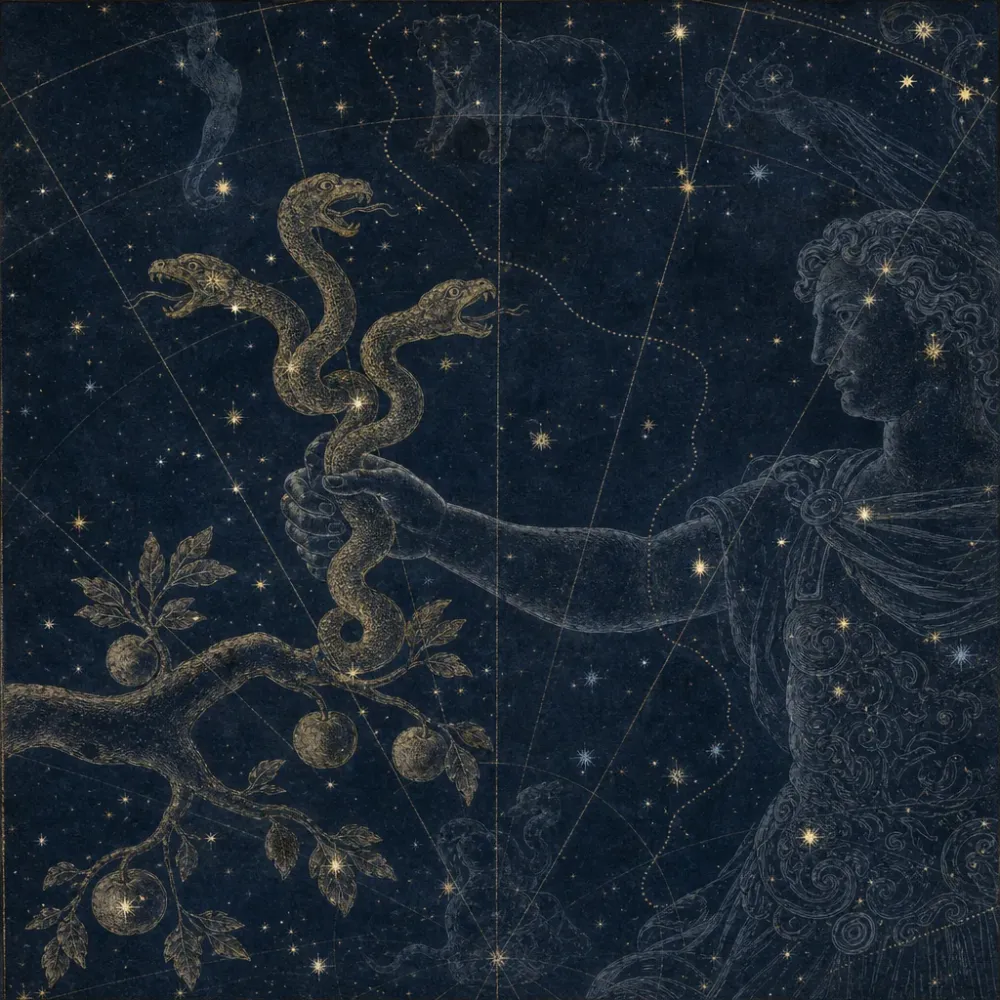
Constellations feel permanent. They are not. A constellation is an agreement among people about which stars belong together and what they mean, and agreements can lapse. In one corner of Hercules, in a scatter of faint stars you would never notice on your own, there used to be a dog. You could not see it unless someone had shown you where to look. Now nobody shows you, and so it is gone.
The hound at the gate
In the myths, Cerberus is the watchdog of the house of Hades, the underworld. He lets the dead in and never lets them out. Hesiod, the earliest source to describe him, calls him a monster with fifty heads and a voice of bronze, born of the storm-giant Typhon and the serpent-woman Echidna. Later writers settled on three heads, and Apollodorus adds a serpent for a tail and the heads of snakes rising along his back. The ancient descriptions disagree, but they agree on this: no living person was meant to get past him.
Bringing him up into daylight was the last labour of Heracles, in the order Apollodorus gives. The hero went down through a cave at Taenarum, at the southern tip of the Peloponnese, and asked Hades himself for the dog. Hades agreed on one condition: Heracles must master Cerberus without any weapons. Wrapped in his lion skin, he wrestled the hound by the throat until it gave in, dragged it to the upper world and showed it to King Eurystheus — who was so frightened that he begged him to take it back. Heracles returned the dog to its post. Ovid adds a botanical footnote: where the hound’s foam fell on the ground, the poisonous plant aconite sprang up.
A new dog for an old sky
The Greek sky had no Cerberus. The ancient constellations, as Ptolemy catalogued them in the second century, left plenty of dim regions unclaimed, and in the sixteenth and seventeenth centuries astronomers began to fill the gaps. One of the most energetic was Johannes Hevelius of Danzig, now Gdańsk, a wealthy brewer and city councillor who built his own observatory on the roofs of his houses and measured the positions of more than a thousand stars.
Hevelius invented several constellations that are still in use — the Lynx, the Lizard, the Little Lion, the Fox, the Hunting Dogs, the Sextant and the Shield among them — and a few that did not survive. One of these was Cerberus. Rather than drawing a dog, he showed a three-headed serpent writhing in Hercules’s outstretched hand, as if the hero had just hauled it out of the underworld. His great atlas, the Firmamentum Sobiescianum, was published in 1690, three years after his death, by his wife Elisabeth, herself a skilled astronomer who had worked beside him for years. Some later atlas-makers twined the serpent around a branch of apples, a nod to another labour, the golden apples of the Hesperides.
Redrawn, and forgotten
By the early twentieth century the sky was crowded with rival figures, and astronomers needed one standard map. In 1922 the International Astronomical Union adopted a list of 88 constellations, and by 1930 their boundaries had been fixed as straight lines of the celestial grid. Cerberus was not on the list. Its stars were simply absorbed into Hercules, and the hound faded into the footnotes of old atlases. It is in good company: the sky’s lost constellations include a cat, a printing workshop and a hot-air balloon.
The dog comes back
Mythology has a way of returning. In 2011, astronomers using the Hubble Space Telescope found a tiny new moon of Pluto, and in 2013 it was named Kerberos, the Greek spelling of the hound’s name — the Latin spelling was already taken by an asteroid. It fits. Pluto, the Roman name for the lord of the underworld, now keeps a family of moons named for his realm: Charon the ferryman, Styx the river, Nix the night, Hydra the serpent and Kerberos the dog. When the New Horizons spacecraft flew past in 2015, it photographed Kerberos as a small, dim, double-lobed body. The guardian at the gate had finally been seen.
So there are two ways to remember Cerberus on a summer night. You can find the place where Hevelius drew him, in the empty-looking stars by the hero’s hand, and imagine the serpent heads twisting there. Or you can think of the little moon, far beyond reach of any backyard telescope, circling the dwarf planet named for the god it serves. Both are acts of imagination. Then again, so is every constellation.
Sources and notes
- Hesiod, Theogony 310–312, trans. H. G. Evelyn-White (1914); Apollodorus, Library 2.5.12, trans. J. G. Frazer (1921); Ovid, Metamorphoses 7.406–419.
- Johannes Hevelius, Firmamentum Sobiescianum (1690); many libraries have digitized copies of his atlas and of later ones that show Cerberus.
- The exact outline of Cerberus varied from atlas to atlas, so any modern position is approximate.