
The autumn road · Constellation and myth
The Argonauts: A Golden Ram Overhead, a Ship Below the Horizon
The voyage of Jason is scattered across the whole sky. From Canada we see its beginning clearly, a few of its crew on winter nights, and almost nothing of the ship.
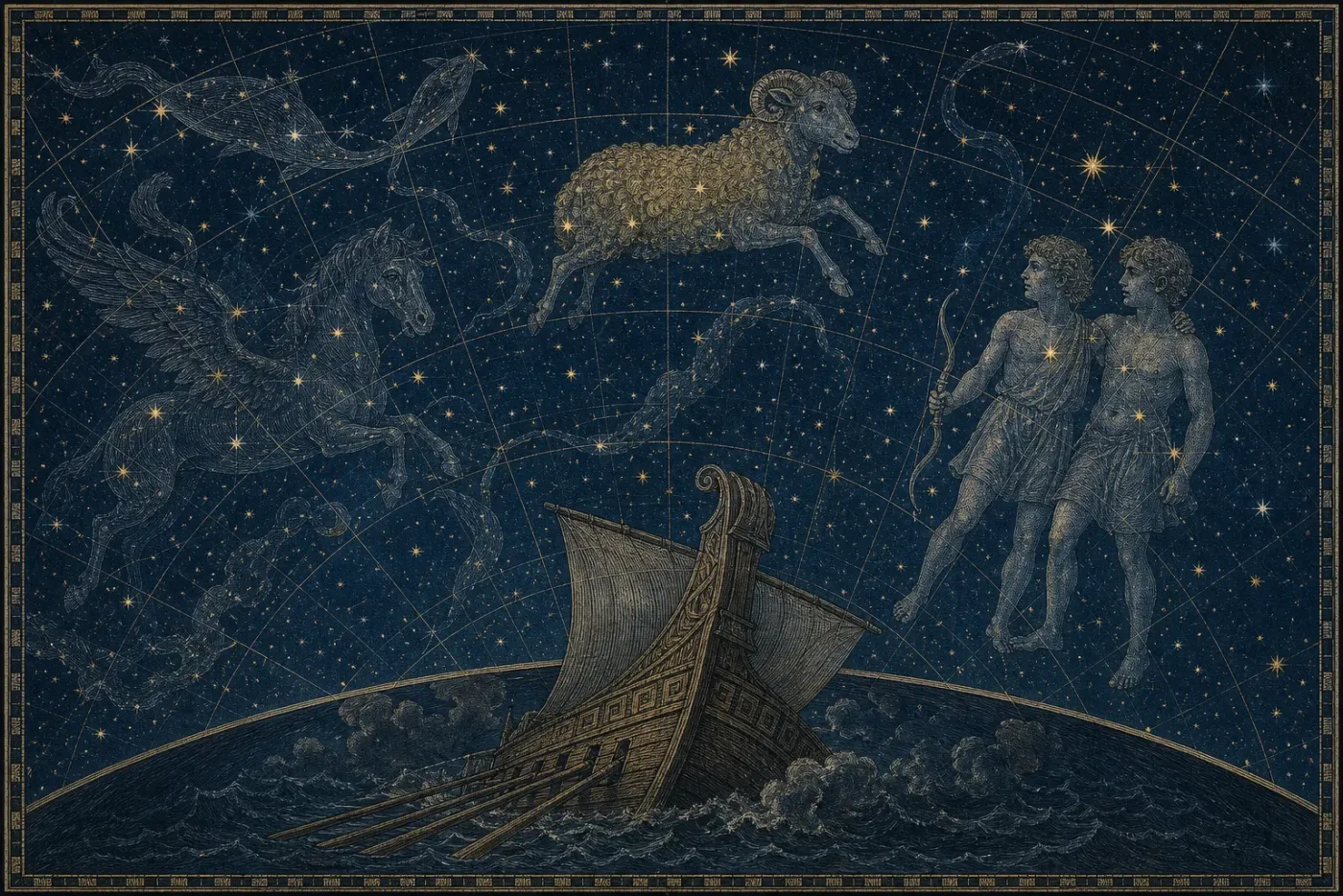
On a November evening, step outside after supper and look high into the south-east. Between the little dipper-shaped cluster of the Pleiades and the big empty Great Square of Pegasus there is a short, bent line of three stars, the brightest a soft gold. It is not much to look at. But it is where one of the great adventure stories of the ancient world begins: the golden ram.
A ram to the rescue
King Athamas had two children, Phrixus and Helle, by his first wife, Nephele, whose name means “cloud.” Their stepmother, Ino, wanted them gone. She persuaded the women of the land to roast the seed grain before it was sown, so that nothing came up; when the king sent to the oracle to ask why, she bribed the messengers to report that the gods demanded the sacrifice of Phrixus. As the boy stood at the altar, his mother sent help: a ram with a fleece of gold, which could fly. Phrixus and Helle climbed on its back and soared away east across the sea.
Only one of them arrived. Over the narrow strait between Europe and Asia, Helle lost her grip and fell into the water, which ever after was called the Hellespont, “Helle’s sea.” Phrixus reached Colchis, at the eastern end of the Black Sea, where he sacrificed the ram to Zeus and gave its golden fleece to King Aeetes, who hung it on an oak in a grove guarded by a serpent that never slept. The ram itself, the star myths tell us, was placed among the constellations: Aries.
Fifty heroes and a talking ship
A generation later, Jason was sent to bring the fleece back by his uncle Pelias, who hoped he would never return. He had a ship built, the Argo, named after its builder Argus and made with the help of Athena, who set into its prow a piece of oak from the sacred grove of Dodona that could speak. The crew were the heroes of a generation, some fifty of them, though the lists differ from author to author: Heracles, who left early in the voyage; Orpheus, whose music could calm the sea; the winged sons of the North Wind; Peleus, the future father of Achilles; and the twin brothers Castor and Pollux.
The fullest telling is the Argonautica of Apollonius of Rhodes, written in the third century BCE. It follows the heroes past clashing rocks and through strange lands to Colchis, where the king sets Jason impossible tasks and his daughter, the sorceress Medea, helps him to master fire-breathing bulls and lull the sleepless serpent so that he can take the fleece. The story grows darker after that, but the sky remembers its brightest moments.
The crew in the winter sky
Two of the Argonauts are easy to find from Canada. Gemini, the Twins, rises in the east on November evenings and stands high in the south on clear January and February nights: two bright stars side by side, Castor and Pollux, with lines of fainter stars trailing from them like two figures holding hands. In the myths the brothers were the special protectors of sailors, and Mediterranean seamen saw them in the electric glow that sometimes plays around a ship’s mast in a storm, later called St. Elmo’s fire. It is a pleasing thought, on a frozen January night, that the twins in the sky were once the guardians of ships.
The ship we cannot see
And the Argo herself? She was one of the largest constellations in Ptolemy’s ancient catalogue, so large that in the 1750s the French astronomer Nicolas-Louis de Lacaille, mapping the southern sky from the Cape of Good Hope, divided her into three: Carina the keel, Puppis the stern and Vela the sails. Those are the names astronomers still use.
But the ship sails in the far southern sky. From southern Canada, only the upper parts of Puppis rise, low over the southern horizon on February and March evenings, and the sails barely skim the treeline from the country’s southernmost points. Carina, with its brilliant star Canopus, the second-brightest in the night sky, never rises anywhere in Canada at all. To see Canopus you would need to travel to roughly the latitude of the southern United States.
There is something quietly right about that. The ram that began the journey rides high above us in autumn, golden and clear. The heroes who sailed in winter stand overhead in the cold months. And the ship that carried them is always just over the edge of our world, still sailing, out of sight.
Sources and notes
- Apollonius of Rhodes, Argonautica, trans. R. C. Seaton (1912), via Project Gutenberg.
- Apollodorus, Library 1.9.1 and 1.9.16–28, trans. J. G. Frazer (1921); Hyginus, Astronomica 2.20 and 2.37.
- The list of Argonauts varies between ancient sources; we name only heroes most lists share.