
Along the Moon’s path · Folklore and the sky
The Vrykolakas and the Eaten Moon
In Greek villages it was the dead who would not rest. A few mountain ranges away, a creature with the same name was blamed for swallowing the Moon. A story for the longest nights.
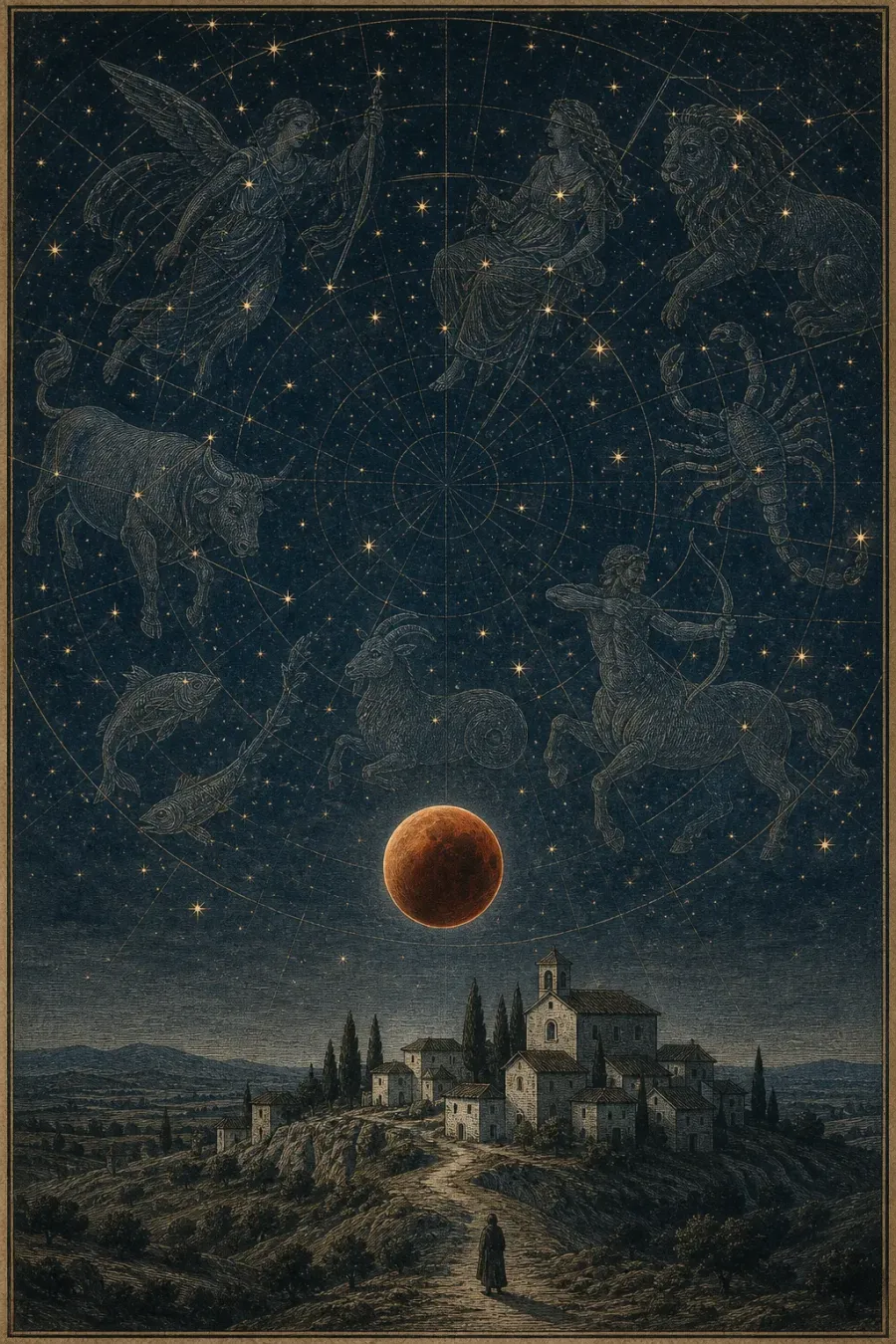
November is the month when darkness wins. The clocks have fallen back, the evenings close in before supper, and in much of Canada the night now outlasts the day by many hours. It is the season when people everywhere have told stories about what walks in the dark. In the villages of Greece, one of those stories had a name that sounds, even now, like a door creaking open: the vrykolakas.
The dead who would not rest
The vrykolakas was not a creature from the ancient myths. It belongs to the folk beliefs of later Greece, recorded from the seventeenth century, when the scholar Leo Allatius wrote about the beliefs of his Greek contemporaries, down to the twentieth, when folklorists such as John Cuthbert Lawson collected village accounts. The details varied from island to island and valley to valley, but the core was steady. A vrykolakas was a dead person who did not stay quiet in the grave. The body did not decay as it should. At night it walked, knocking on doors and calling people by name; in some places it was said that whoever answered the first call would sicken.
People had many explanations for why someone might become one: dying under a curse, or cut off from the church; a violent or untimely death; a burial without the proper rites; even, in some regions, a cat or other animal jumping over the body before the funeral. In some regions the vrykolakas was said to rest in its grave on Saturdays, and those born on a Saturday were believed able to see what others could not. Remedies began with prayers and the priest, and in extreme cases went further. The French botanist Joseph Pitton de Tournefort, travelling in the Aegean in 1701, described a whole town on Mykonos gripped by fear of one such restless corpse; he was skeptical, and his account is as much about panic as about the dead.
It helps to remember the custom behind some of these fears. In many parts of Greece, the dead were exhumed after a few years and their bones gently cleaned and placed in an ossuary. If the body had returned to dust, the soul was thought to be at peace. If not, people worried. The stories grew in the space between love and dread.
A word that ate the Moon
The name itself tells a story of borders. Vrykolakas is not originally Greek. It comes from the South Slavic languages of the Balkans, from a compound that seems to mean something like “wolf-pelt” — in Bulgarian and Serbian folklore the word, in forms such as vǎrkolak and vukodlak, could mean a werewolf. When it crossed into Greek, it changed jobs, from a man who becomes a wolf to a dead person who will not stay dead.
Across the border, the word kept a stranger power. In Bulgarian, Serbian and especially Romanian folklore, where the creature is the vârcolac, it was sometimes said to chase and swallow the Moon or the Sun. When an eclipse darkened the sky, people would ring bells, bang pots and make all the noise they could to frighten it off. Often enough, the Moon came back.
What really happens
What these watchers saw was real. During a total eclipse of the Moon, the full Moon passes into the shadow of the Earth. It does not vanish; instead it turns a deep copper or rusty red, sometimes almost brown. That colour is sunlight that has passed through Earth’s atmosphere and been bent around the planet into the shadow — the light, in effect, of every sunrise and sunset on Earth at that moment, falling on the Moon together. A lunar eclipse can only happen at full Moon, when Sun, Earth and Moon line up, and because the Moon’s orbit is tilted, the alignment comes right only during two short eclipse seasons each year. Not every eclipse is total, and not every one is visible from Canada.
There will be no eclipse at this month’s full Moon, on about November 24 — the one many North American almanacs call the Beaver Moon. But the Moon will do its quieter, everyday magic all the same: rising later each night, sliding about its own width eastward against the stars every hour. Watch it on two evenings in a row and you will see it has moved roughly a hand’s width at arm’s length.
Folklore and astronomy are often presented as opposites, the frightened villager and the calm scientist. The truth is gentler. Both are ways of naming what happens in the dark so that it can be lived with. The people who banged pots at an eclipse were right that the Moon would return. They had simply not yet learned to predict exactly when.
Sources and notes
- J. C. Lawson, Modern Greek Folklore and Ancient Greek Religion (1910), chapter on the revenant; Leo Allatius, De Graecorum hodie quorundam opinationibus (1645).
- Joseph Pitton de Tournefort, Relation d’un voyage du Levant (1717), on Mykonos.
- Beliefs about the vrykolakas varied widely by region; we describe common threads, not a single tradition.